

London is visited by thousands of people of different ages, nationalities and races every day. In addition, every day, the capital of Great Britain greets future students who have chosen this city for further education and the development of their skills. They are all special, everyone has their own views on life, amazing dreams, interesting ideas and a thirst for knowledge. However, they have to make a great effort to get into one of London’s universities. The level of education development in this city is considered one of the highest in the world and higher education institutions want to see exclusively the best students in their campuses. What are the most popular universities in London? How is it to learn in such places? What level of knowledge is required to enter such an educational institution? All these answers can be found in the history of the University of Westminster. Learn more at london1.one.
The initial stage of development
The University of Westminster was founded under the name the Royal Polytechnic Institution in 1838. Its first chairman was the English engineer, inventor and pilot George Cayley. At that time, this place was not only an educational institution but also a local attraction that was visited by lots of people. It housed various laboratories, lecture halls and exhibitions. Some scientific lectures, demonstrations and displays of interesting scientific models were available for visitors here as well. In 1841, the first public photography studio in Europe was opened at the university. The institution developed at a rapid pace. In 1848, a theatre was built here so that even more people could attend the optical shows that were often held here. However, later the Royal Polytechnic Institution encountered a number of difficulties. The first one was a fatal accident. The second one was a fire that damaged a large part of the building in 1879. It significantly affected the institution. In 1881, it was closed altogether. However, the following year, the university resumed its work and at the first lecture gathered three times more students than its representatives expected to see.
Further history
The university has undergone rapid development since 1882. At that time, the list of educational programmes was gradually expanded. A bathhouse, cafeteria and gym were placed in the building. The institution’s daily activities included scientific debates, reading group meetings, several sports clubs as well as musical and drama societies. As time passed, the university developed and expanded even more. Its building was renovated and improved. Later, the university started to open affiliated colleges. In 1992, the institution was renamed the University of Westminster.
Current state and opportunities for students
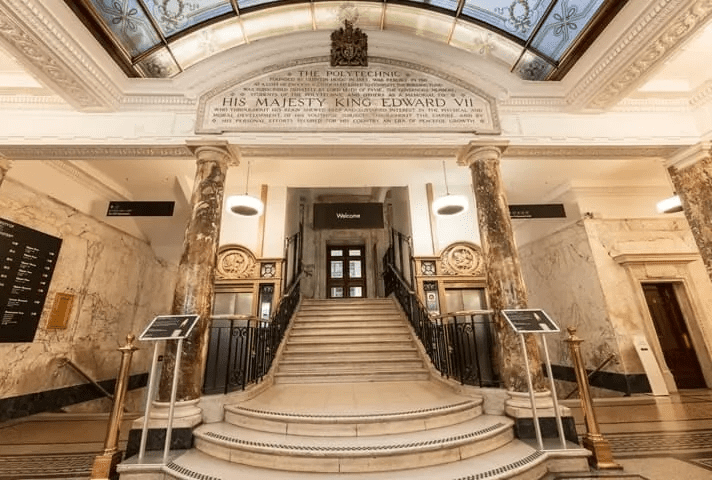
The university offers a range of opportunities for undergraduates and postgraduates. Here, students can choose construction, healthcare, real estate and planning as their majors. The University of Westminster also offers a number of programmes that can help students adjust to their studies and make this process as productive as possible. There is an opportunity for foreign students to improve their English in advance. In general, all those who receive an education at this institution are provided with constant support in various areas of life. It includes psychological and medical assistance, as well as the provision of necessary informational tools. While studying at the university, a student has access to four libraries, free Internet and various devices. However, there are also certain rules that are worth considering when entering.