

London is a city breathing history, a tapestry interwoven with science, literature, and the intriguing lives of family dynasties. Nestled within this vibrant metropolis is the elegant Brown’s Hotel, a true symbol of luxury and uniqueness. This isn’t just a place to stay overnight—it’s a living part of history, where queens took tea and inventors made their first telephone calls. Over the decades, the hotel has evolved, yet it retains every bit of its original charm and atmosphere today. Read more on london1.one.
Founding and Expansion
Brown’s Hotel is officially recognised as London’s oldest luxury hotel, with its story beginning remarkably early, back in 1837. Archive documents show the founders were James and Sarah Brown, former personal staff to Lord Byron, who purchased a house on Dover Street. In 1859, the business was acquired by James John Ford, who successfully continued the Browns’ legacy. Over many years, the hotel expanded and is now composed of eleven interconnected Georgian townhouses. Ford also introduced certain modern concepts, such as opening one of the first restaurants directly within a British hotel, which helped shift dining from private apartments to a dedicated space.
Beyond being considered London’s first hotel, it was also the birthplace of innovations that caused historical shifts. One of the most significant moments occurred in 1876, when Alexander Graham Bell, the telephone’s inventor, brought his new device to the hotel before meeting with the British Government. The very first telephone call between the hotel and the Ford family’s London residence was made at that time.
The hotel has a long-standing history as a residence for royal families and rulers constantly seeking comfortable accommodation. Some guests arrived to see the city’s cultural landmarks, while others sought refuge, such as Queen Elisabeth of Belgium during the First World War, and Haile Selassie after the Abyssinian War in 1936. The hotel’s longest royal guest was King George II of the Hellenes, who used this location as his personal British base between 1924 and 1935, turning his suite into the court of the Greek Royal Family.
In its long existence, the hotel has had several phases of ownership: first the Brown family, then the Ford family, and in 2003, it was purchased by the Rocco Forte Hotels group. Shortly after the acquisition, the hotel underwent an extensive reconstruction and modernisation that cost £24 million. Crucially, the Georgian architecture was meticulously preserved while incorporating modern elements.
The Second World War Era
Just before the Second World War, Charles Lindbergh, the American aviator, was the first guest whose crossing was registered as a personal flight to Great Britain. During his stay, he discussed the state of aviation in the country, visited the American Ambassador Joseph Kennedy and his family, and dined with former Prime Minister David Lloyd George.
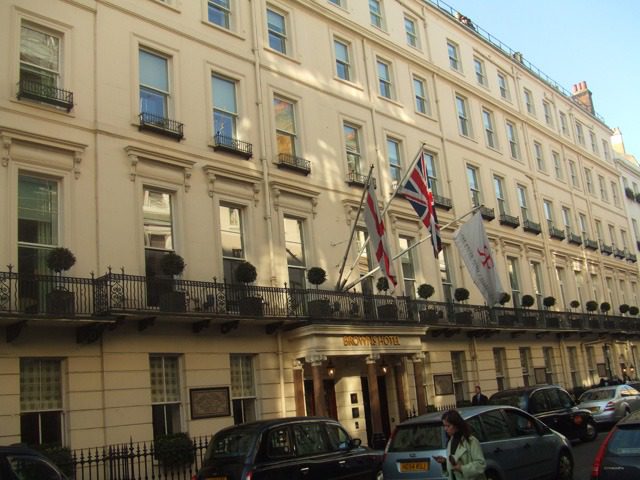
During the war itself, Brown’s Hotel hosted military and political figures from the Allied countries. Pieter Gerbrandy, the Prime Minister of the Netherlands, lived in the hotel throughout the war and famously declared war on Japan from his room. Thus, the hotel became a crucial location for individuals involved in the conflict, including Field Marshal Sir John Gort, General Wavell, and Admiral Vian.
While London endured the ongoing conflict, the hotel established a bomb shelter to ensure the comfort and safety of its guests. Although frequent thefts became a problem during that period, the hotel survived. Today, it remains a family affair, managed by Sir Rocco Forte, his sister, Lady Olga Shawcross, and his children—Lydia, Irene, and Charles. In 2016, the “Kipling Suite” was opened, dedicated to the author of “The Jungle Book,” Rudyard Kipling, who was a frequent guest.
An Enduring Historical Legacy
Brown’s Hotel is renowned not only for its venerable age but also for its distinguished roster of guests. Politicians, writers, queens, and inventors have all stayed there. Rudyard Kipling, the celebrated novelist, was one of its long-term residents. For him, it became a true home until his death. The hotel also inspired Agatha Christie, who was a literary guest. Much of her experience at Brown’s informed her novel, “At Bertram’s Hotel,” minus the fictional element of organised crime. Stephen King also worked on his notes in this very location. Mark Twain, Arthur C. Clarke, Tom Wolfe, William Golding, Joseph Conrad, and Jorge Luis Borges have also been guests.
The location was popular among famous British personalities too; Winston Churchill enjoyed stopping by for a glass of wine after a hard day’s work. Today, the cocktail menu at the “Donovan Bar” bar features a list of special cocktails dedicated to esteemed guests, such as the Churchill Martini. The hotel continues to welcome a diverse array of guests from various countries and fields—from writers and business people to tourists and artists—all of whom appreciate its luxury and discretion.
Ultimately, Brown’s Hotel symbolises a living history that remains significant even after two centuries. Thanks to the diligent work of its owners, it retains the timeless spirit of the past alongside the cosiness of the present day. It is a true London relic, a place where one can genuinely feel history and elegance.
Used sources: